Commercial · Stouffville
Panic & Exit Hardware in Stouffville
After the fit-out, the gym floor now holds more people than the old office space ever did, and the exit door at the back still has the same turn-lock it had when the room held desks.
In plain words
A code trigger usually starts the conversation: an occupant load over a threshold, a fire inspector's note, or a new use for a room that used to hold far fewer people. From there the visit works out which openings are affected, what device and trim suit each one, and whether a pair of doors needs a coordinator or a mullion removed. The installation follows a template, and every device is tested for release force and full latch engagement before the visit ends, with a written record of what went on the door for anyone reviewing the space afterward.
How the visit goesA padlock went on the stockroom's back door years ago for security and nobody has thought about it since, until the walkthrough this week pointed out that the same door is the room's only other way out.
Panic & Exit Hardware
How the visit goes
What the access-control side of the door needs
When a card reader, keypad or intercom is part of the plan, the assessment includes a conversation about the exit side of the same door: does the reader need a request-to-exit signal so the panel knows someone left rather than forced the door, and does the door need electric latch retraction so it can be released remotely without ever compromising the crossbar's push-to-exit function. These questions are answered before the device is ordered, because retrofitting an electrified function onto hardware chosen without it in mind rarely goes cleanly.
Choosing the device for the opening
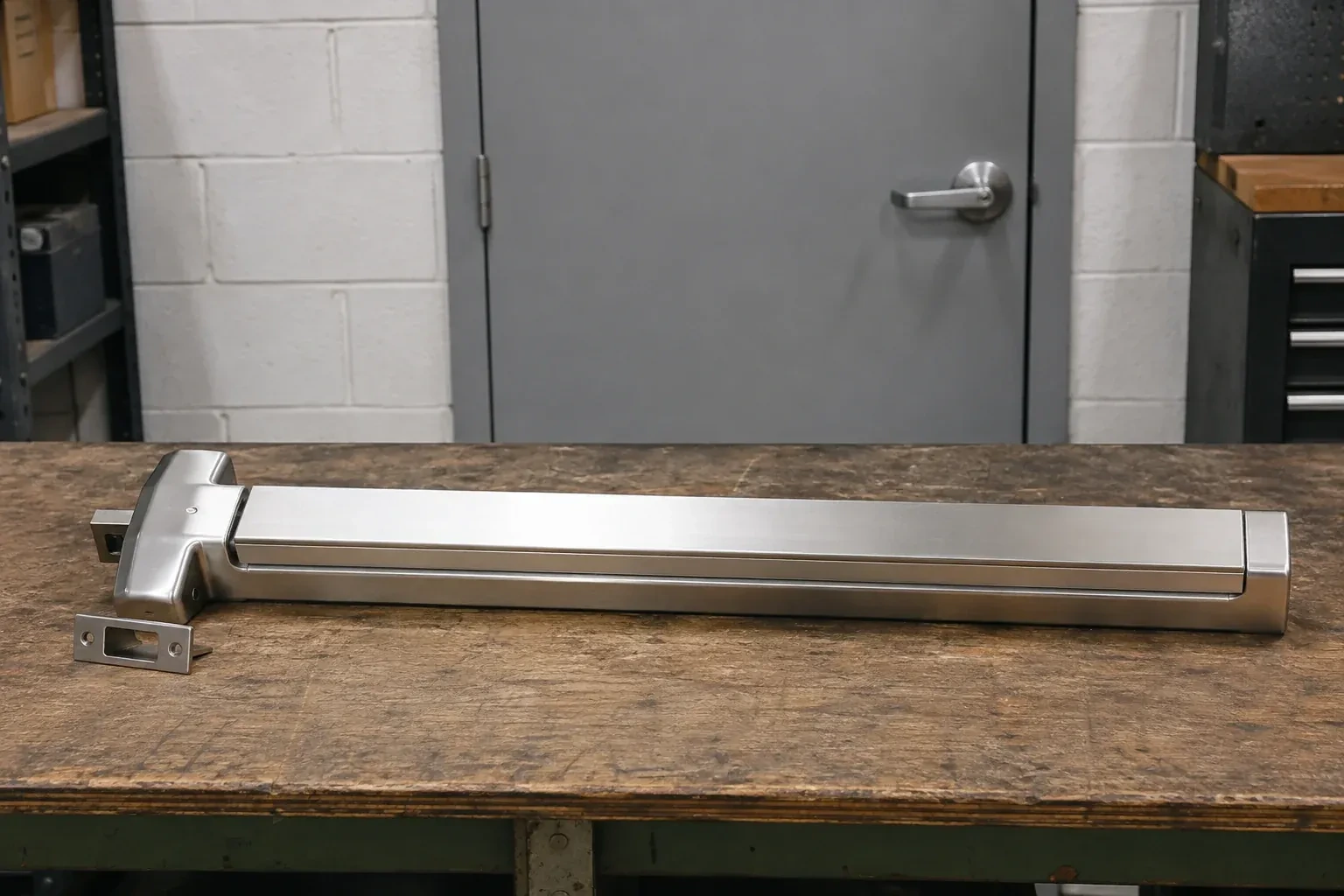
With the assessment done, the locksmith matches a device family to the door: a rim exit device for most single doors, a mortise device where a heavier-duty case suits the opening, or a vertical-rod device where latching is needed at both the top and bottom of the frame. Fire-rated openings take fire exit hardware specifically listed for that duty, never a standard panic device pressed into a role it was not built for, and listed rim fire-exit hardware covers a wide range of those openings on its own. The chosen device is matched to the door's width, handing and existing preparation before it is ordered.
A pair of doors that behaves like one exit
Where a pair was involved, both leaves now latch the way that pair's hardware was designed to: some close in a fixed order guided by a coordinator, with an astragal or a compatible vertical-rod arrangement keeping the opening reading as a single wide exit, while others latch independently on their own without needing either. Anyone walking through it day to day should notice nothing except a door that swings, closes and latches without a hand having to guide the second leaf into place.
Panic & Exit Hardware
In the van
Force gauge
Installation template and jig
Request-to-exit switch
Door closer
Signage and labels
Panic & Exit Hardware
What affects the quote
Single door or a pair
A pair of doors that needs ordered closing calls for a coordinator or an astragal, and one being converted into a single wide exit needs a mullion removed and replaced with vertical-rod devices on each leaf, both of which add work beyond a single-door installation.
Fire-rated versus non-rated opening
A fire-rated door needs hardware specifically listed for that assembly and installed to keep the rating intact, which is more involved than fitting a standard device to a non-rated door.
Removing hardware that should not remain
A padlock, hasp or extra deadbolt found on the door is removed and the resulting holes are filled or covered as part of the same visit, which is its own small task in the quote.
What to have ready
- Is the existing hardware still working, or does it need replacing outright?
- Are any of the doors exterior and exposed to weather?
- Who should hold the dogging key once the work is finished?
Panic & Exit Hardware: questions
QuestionsWho is responsible for keeping the hardware compliant?
The building owner or the party the owner assigns, often a facilities manager, is responsible for keeping exit hardware in working order and for the fire door assembly testing that goes with it. A locksmith installs and services the hardware and can keep records on the owner's behalf, but the ongoing duty to maintain the assembly sits with whoever holds the building.
What happens with a pair of doors instead of one?
It depends on the pair. Some latch independently and need nothing extra. Where the hardware calls for a set closing order, a coordinator lets the two leaves close in the right sequence, letting the active leaf's device seat properly into a strike carried on the inactive leaf, or into an astragal. Alternatively, the centre mullion can be removed and a vertical-rod device fitted to each leaf, turning the pair into one wide exit. Whichever applies, both leaves are tested working together, not one at a time.
What is dogging, and can every door have it?
Dogging holds the device's latch retracted so the door works as a simple push-pull for a period, useful during business hours on a busy entrance. It is not available on fire-rated openings, because a fire door must keep an active latch at all times; on those doors, electric latch retraction achieves a similar push-pull convenience without ever leaving the latch mechanically held back.
Related services
- Master Key System DesignThe new wing was built with its own brand of cylinder, so the two-year-old keys from the original building do not open a single door in the addition.
- Access Control InstallationSomething went missing from the storeroom over a weekend, and when you ask who was in the building, the honest answer is anyone with a key.
- Commercial-Grade Lock ReplacementHead office wants every branch keyed alike under one system, and half the locations are still running whatever lockset the original contractor happened to install years ago.